JORDAN B. SMITH JR. Ed.D.
Data Into Action
Dr. Jordan B. Smith Jr. transforms raw K-12 attendance data into decisive, measurable outcomes. Through the Educator Innovation System (EIS), he bridges military precision and academic leadership to eliminate the million-dollar empty seat and drive real instructional gains.

Measured Impact
Projected EIS Return on Intervention
The Educator Innovation Sandbox measures success through Return on Intervention—not simply return on investment. EIS tracks whether timely, relationship-centered interventions improve student attendance, reduce tardiness, strengthen family engagement, and return instructional time to educators.
Fewer chronically absent students and missed instructional days
Reduced tardiness and recovered classroom learning time
Faster response to early attendance warning signs
Increased successful student and family contacts
Fewer staff hours spent on repetitive outreach and documentation
Attendance-related funding protected or recovered
The financial calculation is straightforward:
Projected EIS Return = attendance-related revenue protected + staff time recovered − implementation cost
The greater return, however, is human: a student reconnected to school, an educator equipped to intervene earlier, and an empty seat restored to learning. EIS is designed to be implemented for less than the value of one student’s recovered attendance—while creating the capacity to positively affect many more.
40 Years of Command & Classroom Leadership
Forged In Service
For twenty years in the United States Marine Corps, leadership was never a theoretical exercise. It was the rigorous execution of systems thinking in high-stakes, uncompromising environments. Every operation demanded absolute discipline, structural integrity, and a relentless focus on measurable outcomes.
When I transitioned to alternative education, I encountered a different kind of crisis: disconnected students abandoned by conventional schooling. The battlefield changed, but the strategy did not. Over the next two decades, I translated military operational frameworks into precise educational interventions—building systems to rescue, re-engage, and graduate the students that traditional methods left behind.

The Framework
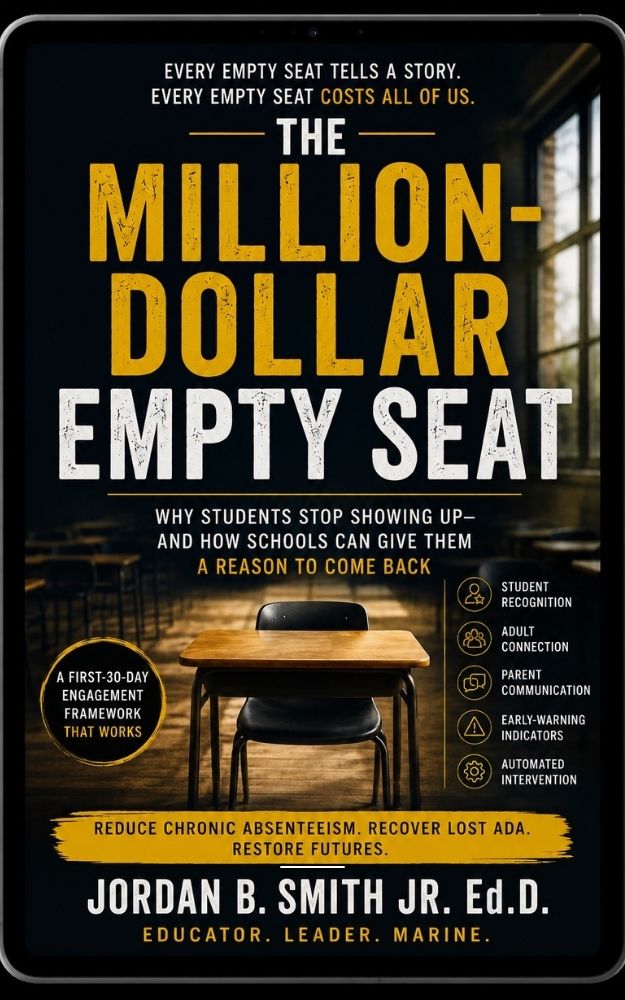
The Million-Dollar
Empty Seat
Every vacant desk represents a compounding crisis—a dual loss of academic potential and critical district revenue. Chronic absenteeism can no longer be treated as an administrative headache or a compliance checklist; it is a fundamental breakdown in student engagement that requires a disciplined, systemic response.
This framework provides the mathematical and operational clarity to uncover your true fiscal exposure, design progressive interventions, and execute a 30-day test of change. It provides leaders the tools to move beyond punitive measures and implement effective re-engagement science.
SYSTEM ARCHITECTURE
The Educator Innovation System
A rigorous, continuous-improvement model that aligns early recognition, active communication, and disciplined intervention to bring students back into the classroom.
Early-Warning Indicators
Identify specific attendance risks and subtle behavioral shifts before they escalate into chronic absenteeism, allowing for proactive intervention.
Assigned Follow-Up
Trigger structured, automated outreach and assign clear, actionable intervention tasks to the most appropriate personnel in your district.
Continuous Improvement
Measure the direct impact of every intervention cycle, converting attendance data into a disciplined 30-day test of operational change.
Command & Credentials
US Naval Academy
Doctor of Education
Amazon Future Engineer
WASC Accredited
DECISIVE ACTION
Take Command
Move from collecting data to assigning action. Access the Million-Dollar Empty Seat resource to convert attendance concerns into a disciplined 30-day test of change.
or join as a Founding Partner
Reconnecting students to their educational journeys through disciplined leadership, systemic innovation, and actionable K-12 intervention.


© 2026 Dr. Jordan B. Smith Jr. All rights reserved.